
Wholesome Badass

A Work in Progress — Healing from All the Things​

Woman surrounded by flames with the words, “Don’t set yourself on fire to keep others warm.”

When Accountability Flows in Only One Direction

For more than 40 years, I didn’t really know how to exist inside a relationship unless I was the broken one, bowing in reliance to anyone gracious enough to let me hang around, no matter the quality of treatment. Could you stay with me? Could you help me? What have I done to be so lucky to have someone strong and knowing and right like you? Barf. Fangirl, fawning, degrading shit. I knew how to engage only that way. What I’m learning now is something different. I don’t want to have to be broken to belong. I am going off script. This is wildly unpopular with the patterned archetypes I have gone barreling toward at every opportunity. I no longer agree to that—to matter less so that a relationship may continue. I cannot abandon what I know and adopt someone else’s perspective in place of my lived experience. That is me gaslighting myself. I cannot accept someone else’s explanation of my motives when it isn’t mine. I can be wrong. I can fuck up. I can apologize. I can change. But I have to remain a whole person while I do it. And the relationships that have cost me the most have not been the ones where people hurt me or got things wrong. They have been the ones where somehow there was always something for me to examine, own, apologize for or change, and nothing on the other side of the relationship was ever available for the same examination. I welcome the responsibility to own my part. I cannot own yours too. My hunger for connection has kept me engaged in things long after I knew they weren’t feeding me. Hunger will do that. But if my body is asking for fiber and what’s being offered is refined sugar, eating it because I’m hungry doesn’t nourish me. It’s not nothing. But it’s not neutral either. I won’t keep feeding myself the opposite of what I’m hungry for and then wonder why I feel poisoned. And feel shame for my resulting condition. So yes. Some relationships may cost too much to keep. Not because they don’t matter to me. Because I finally matter too. Have you ever been tangled up with someone like this? Someone where every attempt to address a conflict somehow ends with you being the only person under examination? They didn’t misunderstand. They didn’t contribute. They didn’t hurt you. They didn’t get anything wrong. You did. Every fucking time….Whatever else may be true, this also happened.

Read More
A warmly lit room with an open closet, hanging clothes, photographs, books, keepsakes, boxes, and a ceramic mug surrounding a scattered pile of personal belongings. The image includes the quote, "Nothing ever goes away until it has taught us what we need to know," by Pema Chödrön.

Making Sense of Life Through Patterns

With all of the therapy, writing, reading, reflection, and somatic work, a lot is coming up for me. Memories. Patterns. Correlations that I had not previously made. I am finding that this process is much less like the discovery of something new and much more like noticing something that has been there all along. I would describe it as so much stuff from the past lying in a tangled heap on a closet floor, too overwhelming to tackle or ignore. Slowly, I am making order of it, identifying items and events, and putting them in their places. The tangled mess shrinks, and the grip of it all is loosening. I am also discovering that memory is a strange thing. I don’t trust every detail, every conversation, or every interpretation. But I do trust patterns, especially those that repeat themselves in what seems like perpetuity. I am trying very hard to engage this with humility, admitting my blind spots. I recognize that other people have had different experiences and interpretations. I can’t know intent or motivation, but only I can name the impact they have had on me.

Read More
Black-and-white illustration of a smiling priest holding someone underwater during a baptism. A crowd admires him while a concerned girl notices the harm.

Perception vs. Reality

There is a scene in Boardwalk Empire in which a priest is standing in a river performing a baptism. He is wearing white robes. He is smiling. He occupies a position of moral authority. He presents as a good man offering salvation. The priest is holding the man beneath the water, while keeping a calmly arranged placid smile on his face, his confidence in plausible deniability. Here is a man cloaked in goodness, purity, and authority, protected by the very role that allows him to publicly and confidently carry out something profoundly sinister. People see the robes, the smile, the holy father offering salvation. His authority goes unchecked because the story has already been written. The role itself pre-decides what is possible to notice. In that way, the people witnessing from the shore become part of the story as well. The disturbance is not confined to the harm itself. It is also the protection, restoration, accommodation, and assumption of goodness that surround it. It is the way the narratives that shape our understanding pre-decide what is possible to notice.

Read More
An empty courtroom with light shining across the judge's bench and the words, "When the aggressor occupies the protected position ..." superimposed over the image.

The Protected Position

Something began when I was four years old, and it was reinforced, repeated, normalized, and sustained over the course of decades. The injury wasn’t only the abuse itself. It was also the fact that the person who harmed me was favored, protected, believed, accommodated, and repeatedly restored to a position of legitimacy while I was not. Something bad happened, and the person who did it continued to occupy a protected position while my reality (moments of distress) was judged, minimized, and dismissed. When that happens over and over again, year after year, it makes sense that I began to feel as though my validity, agency, credibility, and even my right to define my own experience had been stripped away. For a very long time, I located the center of gravity in my mother. Now I am considering the possibility that my sister occupied a much more influential position than I had been able to discern. Six and a half years older than me, she was the first grandchild, the first niece, and the favored child. Then came Magda, the last grandchild: highly sensitive, tightly wound, easily activated, and in need of inconvenient soothing. My sensitivity was dismissed as performance. “Quit performing. Stop being dramatic, hysterical, manipulative. Stop trying to get attention.” Nobody taught me how to cope with difficulty, tolerate discomfort, or regulate my nervous system. I think my sister learned that there was power in being able to suck it up and may even have come to feel martyred by it. By keeping me dysregulated through taunting, provocation, and unwanted touching, she gained traction through the contrast in presentation. She appeared composed while I appeared reactive, and ours was a family with very little capacity for visible, observable, unhidable struggle. As I continue to heal, I find myself repeatedly encountering variations of this same pattern. There is a certain kind of personality that seems to require constant elevation, admiration, accommodation, and preferential treatment, and there is a predictable response to anyone whose presence threatens to divert attention from that arrangement. The archetype itself is hardly new. If only authority were evidence of integrity and virtue. If only age, status, confidence, accomplishment, popularity, or proximity to power guaranteed goodness. I was placed on this trajectory at the age of four, and now I am doing the work required to change direction. I am learning to recognize the pattern that I know so well and, without vigilance, continue to mistake for love, safety, familiarity, and home. The familiarity calls to me. Like an old glove, it simply fits. I recognize now that familiarity and safety are not the same thing. Whatever else may be true, this also happened.

Read More
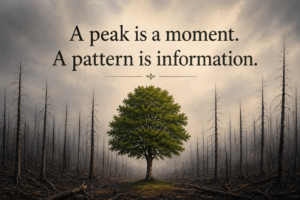
One healthy green tree standing in the middle of a forest of dead trees beneath the quote, “A peak is a moment. A pattern is information.”

The Truth Is in the Pattern

Sheesh. How many more times will I have to navigate this particular circuit before I have learned everything I can from it? The turth is in the pattern, not the explanation. It almost feels as though I have been given a false map. There are things people say that, if I allow them to guide me, will take me completely off course because they don’t align with reality, their actions, or my lived experience. I am starting to recognize that the real story lives inside the patterns. Words do matter. Conversations matter. Moments matter. But patterns persist regardless of what is said. Sometimes there is an incongruency or lack of alignment between words, the suggested intent of those words, and actions. Sometimes things are not communicated directly at all, and yet they are communicated clearly through repeated behaviors. I am intentionally allowing patterns to inform me more than peak moments, conversations, or exchanges. If there is a pleasurable moment in a relationship, I can no longer hold onto that moment as though it represents restoration or the relationship as a whole. I will not waste energy trying to figure out how to get back to that place, as though I have somehow lost the thread. Perhaps it was the exception. Possibly, it was simply a moment. The information is in the pattern. That doesn’t necessarily tell me what is true in some absolute sense, but it does tell me what is real. And when I allow patterns to inform what I say or do next, I am able to remain aligned with my quest for sovereignty and radical neutrality. A thing has happened. I don’t get to change it, reinterpret it, or spin it into something else. I don’t have to lose myself reacting or trying to understand it from every possible angle. I don’t have to overexplain my experience or convince anyone else of it. I can simply acknowledge what is and decide what my actual options are, keeping in alignment with my North Star. Whatever else may be true, this also happened.

Read More
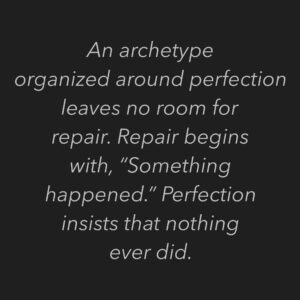
Black-and-white typography graphic with a quote about how relationships require acknowledgment of ruptures in order to repair, and how perfectionism can prevent emotional repair and trust.

When Relationships Stop Evolving

I’ve spent a lot of time thinking about the c-word….”conflict ” and also–avoidance and repair. The archetype, to whom I have gravitated to like a moth to a flame, seems to have little room for either. Being non-pleased feels unacceptable. Causing displeasure feels unacceptable. Being imperfect feels unacceptable. So concerns don’t get raised directly. They leak out sideways through passive aggression, distance, stonewalling, or the preTENSE that everything is fine. The script for that: All good. Everything is fine. No worries. Of course. Perfect. No problem. Good vibes only. smile emoji lol And if someone does directly bring up a concern, the conversation can quickly shift to intentions, perceptions, or disproving any negative impact in the first place. I’ve lived inside enough of those relationships to recognize a clear pattern. One conversation with Sweet Greg from years ago–went differently. I brought up something that would have been disruptive to just about anyone. And he began his reply by explaining his intentions and my perceptions. I finally said, “If the only version of this conversation is the one where everything supports that you had no negative impact, our season has ended. Not because that issue was dramatic or catastrophic but because that manner of communication after conflict is one I’m too familiar with.” That changed the conversation. We stopped trying to establish innocence. We started talking about the impact, which is unmitagted by intention. Neither of us had to be the bad guy. Neither of us had to abandon our dignity. After that, we spent the next six years intentionally getting better at repair. Not because we had constant conflict. Because neither of us had to wonder. If something landed wrong, we said it. If one of us missed the mark, we talked about it. If an apology was needed, it wasn’t treated like a character indictment. Those moments were not dramatic. Most of them were like paper cuts, as far as gravity. But a thousand paper cuts can finally erupt by with irreperable injury. Left alone, “paper cuts” have a way of becoming stories that the cutty tells themselves about how little they matter. Addressed early, they become moments of understanding. Maybe that’s what repair has felt like to me. Not the absence of conflict. The absence of guessing and ruminating. The freedom to ask, “Did something happen?” without fearing the question itself. The freedom to hear, “That landed differently than you intended,” without feeling like either person has to lose. It became natural to laugh at ourselves, own our blind spots, and keep moving toward each other instead of away from each other. That kind of repair didn’t make either of us perfect. It made us close. I’ve only experienced that kind of relationship a handful of times. I think I understand something now that I didn’t then. For me, relationships no longer end because of conflict or a fight. For me, the season has concluded when evolving and expanding have stopped. When there’s not room to speak truth, make an adjustment, extend grace, laugh at ourselves, or discover a better way of loving each other. Or maybe the season just ends, but not because of a fight. And nobody is left to wonder, what did I do or what is going on? Whatever else may be true, this is my experience.

Read More
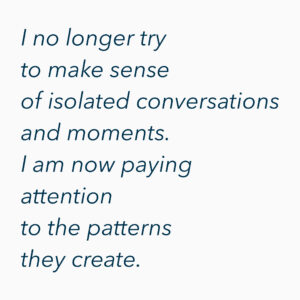
A minimalist quote graphic that reads, "I no longer try to make sense of isolated conversations or moments. I pay attention to the patterns they create." The image reflects themes of self-trust, relationship patterns, emotional healing, and personal growth.

If There Had Been a Fly on the Wall

Memory Memory can be unreliable. Interpretation certainly is. Two people can experience the same interaction and leave with very different narratives about what happened. What feels more meaningful to me now is paying attention to patterns that could have been observed by someone with no emotional investment. A quiet witness. A fly on the wall. Not someone deciding who was right. Just someone noticing what happened. Here are some of the things I believe that fly on the wall would have witnessed. -concerns met with defensive explanations more often than curiosity -hurt followed by rebuttal instead of repair -long conversations devoted to why my experience was inaccurate, exaggerated, unfair, or incomplete, while the original concern quietly disappeared -accountability flow much more comfortably in one direction than the other -apologies followed by explanations that softened or erased accountability -requests for change become deep dives into my shortcomings -a basic conflict become a courtroom instead of a collaboration They would have seen me trying harder. Communicating more carefully. Choosing my words more precisely. Waiting for better timing. Trying different approaches. Apologizing for trying so hard. Hoping that one more adjustment on my part would finally create the relationship I longed for and believed possible. They would have seen moments of warmth. Humor. Affection. Thoughtfulness. Hope. Those moments were real. They were also unpredictable. And they were enough to keep me believing things could be different. But they would have also seen those moments disappear without much explanation, leaving me searching for what had changed and what I needed to do differently to bring them back. They would have seen important conversations postponed until they quietly disappeared. Promises made in emotional moments but rarely translated into lasting change. They would have seen responsibilities become negotiable when they belonged to him and urgent when they belonged to me. They would have seen me begin monitoring his mood before bringing up difficult subjects. Editing my feelings before sharing them. Trying to predict which version of him I would be speaking to that day. Eventually, the fly on the wall would have noticed something else. The conversations were not reflective of two people trying to solve a problem together. But conversations about whether I had the right to have the problem in the first place. Over time, that changed me. I began wondering whether my expectations were too high. Whether my memory was inaccurate. Whether my nervous system was defective. Whether my needs were simply too much. Looking back, I no longer think any single interaction tells the story. The story is the repetition. Not because repetition proves someone’s intentions. It doesn’t. But repetition reveals the emotional climate a relationship creates. I don’t know why another person behaved the way they did. I no longer spend much time trying to answer that question. The question that matters to me now is much simpler. Who was I becoming and what was I agreeing to while I was trying so hard to make sense of it? Whatever else may be true, this is my experience.

Read More
Illustration of two one woman sharing details of someone else's private struggle. And being praised for kind thoughtfulness. The woman they are discussing sits nearby, unaware.

The Irony of Weaponized Concern

The Reality of Gossip Discussing the details of someone else’s life—their hardships, their choices, or how they live—is a fundamentally unwholesome practice. Gossip happens, and we can be honest about that and not pretend that engaging in it is useful, considerate, or kind.  The “Concerned” Persona So it is fascinating to witness someone who is known for not being particularly fond of a person take an openly concerned stance in sharing the depth of their worry for that person’s wellness, stability, and functionality. The energy attempt:  “I’m only saying this because I care…” Engineered Destabilization It is a stunning social loophole. Cloaking gossip with empathy, is an attempt to engineer a kind of social undermining while seeking praise for thoughtfulness. If I knew how to do emojis from my Mac- Barfing emoji for sure right fkn here. The Blind Spot What is confusing, is how easily bystanders buy the act. How does a person or group look at someone with an obvious grudge or bias, listen to them trade in the unfavorable assessment of another person’s private life, and see a caring soul instead of an invasive, scheming act? Skull and Crossbones emoji here. The Performance vs. Real Consideration Genuine care and consideration tend to be quiet and direct and require no recognition. They check in and ask what they can do to help. They honor respect and privacy with discernement and intention. When the “concern” is instead passed around from person to person, it isn’t support—it’s unwholesome gossip disguised as  goodness. It makes you ask “how does a sound person buy into the performance?” Insert Comedy Tragedy mask emoji here. Whatever else may be true, this also happened.

Read More
Woman surrounded by flames with the words, “Don’t set yourself on fire to keep others warm.”

When Accountability Flows in Only One Direction

For more than 40 years, I didn’t really know how to exist inside a relationship unless I was the broken one, bowing in reliance to anyone gracious enough to let me hang around, no matter the quality of treatment. Could you stay with me? Could you help me? What have I done to be so lucky to have someone strong and knowing and right like you? Barf. Fangirl, fawning, degrading shit. I knew how to engage only that way. What I’m learning now is something different. I don’t want to have to be broken to belong. I am going off script. This is wildly unpopular with the patterned archetypes I have gone barreling toward at every opportunity. I no longer agree to that—to matter less so that a relationship may continue. I cannot abandon what I know and adopt someone else’s perspective in place of my lived experience. That is me gaslighting myself. I cannot accept someone else’s explanation of my motives when it isn’t mine. I can be wrong. I can fuck up. I can apologize. I can change. But I have to remain a whole person while I do it. And the relationships that have cost me the most have not been the ones where people hurt me or got things wrong. They have been the ones where somehow there was always something for me to examine, own, apologize for or change, and nothing on the other side of the relationship was ever available for the same examination. I welcome the responsibility to own my part. I cannot own yours too. My hunger for connection has kept me engaged in things long after I knew they weren’t feeding me. Hunger will do that. But if my body is asking for fiber and what’s being offered is refined sugar, eating it because I’m hungry doesn’t nourish me. It’s not nothing. But it’s not neutral either. I won’t keep feeding myself the opposite of what I’m hungry for and then wonder why I feel poisoned. And feel shame for my resulting condition. So yes. Some relationships may cost too much to keep. Not because they don’t matter to me. Because I finally matter too. Have you ever been tangled up with someone like this? Someone where every attempt to address a conflict somehow ends with you being the only person under examination? They didn’t misunderstand. They didn’t contribute. They didn’t hurt you. They didn’t get anything wrong. You did. Every fucking time….Whatever else may be true, this also happened.

Read More
A warmly lit room with an open closet, hanging clothes, photographs, books, keepsakes, boxes, and a ceramic mug surrounding a scattered pile of personal belongings. The image includes the quote, "Nothing ever goes away until it has taught us what we need to know," by Pema Chödrön.

Making Sense of Life Through Patterns

With all of the therapy, writing, reading, reflection, and somatic work, a lot is coming up for me. Memories. Patterns. Correlations that I had not previously made. I am finding that this process is much less like the discovery of something new and much more like noticing something that has been there all along. I would describe it as so much stuff from the past lying in a tangled heap on a closet floor, too overwhelming to tackle or ignore. Slowly, I am making order of it, identifying items and events, and putting them in their places. The tangled mess shrinks, and the grip of it all is loosening. I am also discovering that memory is a strange thing. I don’t trust every detail, every conversation, or every interpretation. But I do trust patterns, especially those that repeat themselves in what seems like perpetuity. I am trying very hard to engage this with humility, admitting my blind spots. I recognize that other people have had different experiences and interpretations. I can’t know intent or motivation, but only I can name the impact they have had on me.

Read More
Black-and-white illustration of a smiling priest holding someone underwater during a baptism. A crowd admires him while a concerned girl notices the harm.

Perception vs. Reality

There is a scene in Boardwalk Empire in which a priest is standing in a river performing a baptism. He is wearing white robes. He is smiling. He occupies a position of moral authority. He presents as a good man offering salvation. The priest is holding the man beneath the water, while keeping a calmly arranged placid smile on his face, his confidence in plausible deniability. Here is a man cloaked in goodness, purity, and authority, protected by the very role that allows him to publicly and confidently carry out something profoundly sinister. People see the robes, the smile, the holy father offering salvation. His authority goes unchecked because the story has already been written. The role itself pre-decides what is possible to notice. In that way, the people witnessing from the shore become part of the story as well. The disturbance is not confined to the harm itself. It is also the protection, restoration, accommodation, and assumption of goodness that surround it. It is the way the narratives that shape our understanding pre-decide what is possible to notice.

Read More
An empty courtroom with light shining across the judge's bench and the words, "When the aggressor occupies the protected position ..." superimposed over the image.

The Protected Position

Something began when I was four years old, and it was reinforced, repeated, normalized, and sustained over the course of decades. The injury wasn’t only the abuse itself. It was also the fact that the person who harmed me was favored, protected, believed, accommodated, and repeatedly restored to a position of legitimacy while I was not. Something bad happened, and the person who did it continued to occupy a protected position while my reality (moments of distress) was judged, minimized, and dismissed. When that happens over and over again, year after year, it makes sense that I began to feel as though my validity, agency, credibility, and even my right to define my own experience had been stripped away. For a very long time, I located the center of gravity in my mother. Now I am considering the possibility that my sister occupied a much more influential position than I had been able to discern. Six and a half years older than me, she was the first grandchild, the first niece, and the favored child. Then came Magda, the last grandchild: highly sensitive, tightly wound, easily activated, and in need of inconvenient soothing. My sensitivity was dismissed as performance. “Quit performing. Stop being dramatic, hysterical, manipulative. Stop trying to get attention.” Nobody taught me how to cope with difficulty, tolerate discomfort, or regulate my nervous system. I think my sister learned that there was power in being able to suck it up and may even have come to feel martyred by it. By keeping me dysregulated through taunting, provocation, and unwanted touching, she gained traction through the contrast in presentation. She appeared composed while I appeared reactive, and ours was a family with very little capacity for visible, observable, unhidable struggle. As I continue to heal, I find myself repeatedly encountering variations of this same pattern. There is a certain kind of personality that seems to require constant elevation, admiration, accommodation, and preferential treatment, and there is a predictable response to anyone whose presence threatens to divert attention from that arrangement. The archetype itself is hardly new. If only authority were evidence of integrity and virtue. If only age, status, confidence, accomplishment, popularity, or proximity to power guaranteed goodness. I was placed on this trajectory at the age of four, and now I am doing the work required to change direction. I am learning to recognize the pattern that I know so well and, without vigilance, continue to mistake for love, safety, familiarity, and home. The familiarity calls to me. Like an old glove, it simply fits. I recognize now that familiarity and safety are not the same thing. Whatever else may be true, this also happened.
Read More
One healthy green tree standing in the middle of a forest of dead trees beneath the quote, “A peak is a moment. A pattern is information.”

The Truth Is in the Pattern

Sheesh. How many more times will I have to navigate this particular circuit before I have learned everything I can from it? The turth is in the pattern, not the explanation. It almost feels as though I have been given a false map. There are things people say that, if I allow them to guide me, will take me completely off course because they don’t align with reality, their actions, or my lived experience. I am starting to recognize that the real story lives inside the patterns. Words do matter. Conversations matter. Moments matter. But patterns persist regardless of what is said. Sometimes there is an incongruency or lack of alignment between words, the suggested intent of those words, and actions. Sometimes things are not communicated directly at all, and yet they are communicated clearly through repeated behaviors. I am intentionally allowing patterns to inform me more than peak moments, conversations, or exchanges. If there is a pleasurable moment in a relationship, I can no longer hold onto that moment as though it represents restoration or the relationship as a whole. I will not waste energy trying to figure out how to get back to that place, as though I have somehow lost the thread. Perhaps it was the exception. Possibly, it was simply a moment. The information is in the pattern. That doesn’t necessarily tell me what is true in some absolute sense, but it does tell me what is real. And when I allow patterns to inform what I say or do next, I am able to remain aligned with my quest for sovereignty and radical neutrality. A thing has happened. I don’t get to change it, reinterpret it, or spin it into something else. I don’t have to lose myself reacting or trying to understand it from every possible angle. I don’t have to overexplain my experience or convince anyone else of it. I can simply acknowledge what is and decide what my actual options are, keeping in alignment with my North Star. Whatever else may be true, this also happened.
Read More
Black-and-white typography graphic with a quote about how relationships require acknowledgment of ruptures in order to repair, and how perfectionism can prevent emotional repair and trust.

When Relationships Stop Evolving

I’ve spent a lot of time thinking about the c-word….”conflict ” and also–avoidance and repair. The archetype, to whom I have gravitated to like a moth to a flame, seems to have little room for either. Being non-pleased feels unacceptable. Causing displeasure feels unacceptable. Being imperfect feels unacceptable. So concerns don’t get raised directly. They leak out sideways through passive aggression, distance, stonewalling, or the preTENSE that everything is fine. The script for that: All good. Everything is fine. No worries. Of course. Perfect. No problem. Good vibes only. smile emoji lol And if someone does directly bring up a concern, the conversation can quickly shift to intentions, perceptions, or disproving any negative impact in the first place. I’ve lived inside enough of those relationships to recognize a clear pattern. One conversation with Sweet Greg from years ago–went differently. I brought up something that would have been disruptive to just about anyone. And he began his reply by explaining his intentions and my perceptions. I finally said, “If the only version of this conversation is the one where everything supports that you had no negative impact, our season has ended. Not because that issue was dramatic or catastrophic but because that manner of communication after conflict is one I’m too familiar with.” That changed the conversation. We stopped trying to establish innocence. We started talking about the impact, which is unmitagted by intention. Neither of us had to be the bad guy. Neither of us had to abandon our dignity. After that, we spent the next six years intentionally getting better at repair. Not because we had constant conflict. Because neither of us had to wonder. If something landed wrong, we said it. If one of us missed the mark, we talked about it. If an apology was needed, it wasn’t treated like a character indictment. Those moments were not dramatic. Most of them were like paper cuts, as far as gravity. But a thousand paper cuts can finally erupt by with irreperable injury. Left alone, “paper cuts” have a way of becoming stories that the cutty tells themselves about how little they matter. Addressed early, they become moments of understanding. Maybe that’s what repair has felt like to me. Not the absence of conflict. The absence of guessing and ruminating. The freedom to ask, “Did something happen?” without fearing the question itself. The freedom to hear, “That landed differently than you intended,” without feeling like either person has to lose. It became natural to laugh at ourselves, own our blind spots, and keep moving toward each other instead of away from each other. That kind of repair didn’t make either of us perfect. It made us close. I’ve only experienced that kind of relationship a handful of times. I think I understand something now that I didn’t then. For me, relationships no longer end because of conflict or a fight. For me, the season has concluded when evolving and expanding have stopped. When there’s not room to speak truth, make an adjustment, extend grace, laugh at ourselves, or discover a better way of loving each other. Or maybe the season just ends, but not because of a fight. And nobody is left to wonder, what did I do or what is going on? Whatever else may be true, this is my experience.

Read More
A minimalist quote graphic that reads, "I no longer try to make sense of isolated conversations or moments. I pay attention to the patterns they create." The image reflects themes of self-trust, relationship patterns, emotional healing, and personal growth.

If There Had Been a Fly on the Wall

Memory Memory can be unreliable. Interpretation certainly is. Two people can experience the same interaction and leave with very different narratives about what happened. What feels more meaningful to me now is paying attention to patterns that could have been observed by someone with no emotional investment. A quiet witness. A fly on the wall. Not someone deciding who was right. Just someone noticing what happened. Here are some of the things I believe that fly on the wall would have witnessed. -concerns met with defensive explanations more often than curiosity -hurt followed by rebuttal instead of repair -long conversations devoted to why my experience was inaccurate, exaggerated, unfair, or incomplete, while the original concern quietly disappeared -accountability flow much more comfortably in one direction than the other -apologies followed by explanations that softened or erased accountability -requests for change become deep dives into my shortcomings -a basic conflict become a courtroom instead of a collaboration They would have seen me trying harder. Communicating more carefully. Choosing my words more precisely. Waiting for better timing. Trying different approaches. Apologizing for trying so hard. Hoping that one more adjustment on my part would finally create the relationship I longed for and believed possible. They would have seen moments of warmth. Humor. Affection. Thoughtfulness. Hope. Those moments were real. They were also unpredictable. And they were enough to keep me believing things could be different. But they would have also seen those moments disappear without much explanation, leaving me searching for what had changed and what I needed to do differently to bring them back. They would have seen important conversations postponed until they quietly disappeared. Promises made in emotional moments but rarely translated into lasting change. They would have seen responsibilities become negotiable when they belonged to him and urgent when they belonged to me. They would have seen me begin monitoring his mood before bringing up difficult subjects. Editing my feelings before sharing them. Trying to predict which version of him I would be speaking to that day. Eventually, the fly on the wall would have noticed something else. The conversations were not reflective of two people trying to solve a problem together. But conversations about whether I had the right to have the problem in the first place. Over time, that changed me. I began wondering whether my expectations were too high. Whether my memory was inaccurate. Whether my nervous system was defective. Whether my needs were simply too much. Looking back, I no longer think any single interaction tells the story. The story is the repetition. Not because repetition proves someone’s intentions. It doesn’t. But repetition reveals the emotional climate a relationship creates. I don’t know why another person behaved the way they did. I no longer spend much time trying to answer that question. The question that matters to me now is much simpler. Who was I becoming and what was I agreeing to while I was trying so hard to make sense of it? Whatever else may be true, this is my experience.

Read More
Illustration of two one woman sharing details of someone else's private struggle. And being praised for kind thoughtfulness. The woman they are discussing sits nearby, unaware.

The Irony of Weaponized Concern

The Reality of Gossip Discussing the details of someone else’s life—their hardships, their choices, or how they live—is a fundamentally unwholesome practice. Gossip happens, and we can be honest about that and not pretend that engaging in it is useful, considerate, or kind.  The “Concerned” Persona So it is fascinating to witness someone who is known for not being particularly fond of a person take an openly concerned stance in sharing the depth of their worry for that person’s wellness, stability, and functionality. The energy attempt:  “I’m only saying this because I care…” Engineered Destabilization It is a stunning social loophole. Cloaking gossip with empathy, is an attempt to engineer a kind of social undermining while seeking praise for thoughtfulness. If I knew how to do emojis from my Mac- Barfing emoji for sure right fkn here. The Blind Spot What is confusing, is how easily bystanders buy the act. How does a person or group look at someone with an obvious grudge or bias, listen to them trade in the unfavorable assessment of another person’s private life, and see a caring soul instead of an invasive, scheming act? Skull and Crossbones emoji here. The Performance vs. Real Consideration Genuine care and consideration tend to be quiet and direct and require no recognition. They check in and ask what they can do to help. They honor respect and privacy with discernement and intention. When the “concern” is instead passed around from person to person, it isn’t support—it’s unwholesome gossip disguised as  goodness. It makes you ask “how does a sound person buy into the performance?” Insert Comedy Tragedy mask emoji here. Whatever else may be true, this also happened.
Read More