
I came into the family as the youngest, with a tightly wound nervous system and a way of taking in the world that was unusually sensitive—to sensory and emotional input, even to chemical sensitivity to foods.
What I recognize is how easily my unbridled and frequent emotional displays of despair could steal the show. Once I was visibly distressed, the distress itself was identified as the only issue. Only in 12-step recovery did I learn to withhold the gift of distraction of my reaction.
Before developing the metacognitive ability or language to name what was happening inside me, I certainly failed to make a persuasive case for myself. Even with the language, there has not been a person I am genetically linked to who has attempted to understand.
I do not recall being met with curiosity by any single person, much less consistently, to genuinely inquire about what I was experiencing or what I might need. Only correction, judgment, banishment, and even mocking by the actual adults.
It was as though there was one established way to deal with me.
I will refer to that as the branding. The packaging. The lens through which everything about me was to be processed and handled.
The fact of my discomfort, which went unconsoled and therefore persisted and compounded, was treated as evidence that something was fundamentally wrong with me.
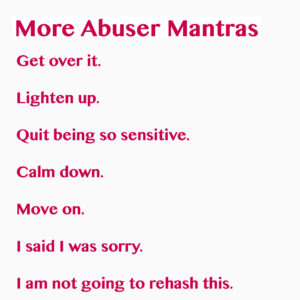
Dramatic. Histrionic. Too sensitive. Attention-seeking. Always the problem with problems.
Over time, the branding evolved into a kind of maybe like vilification. Definitely an othering.
Whatever I was reacting to could safely disappear behind the reaction.
That created the ecosystem in which anything reductive, degrading, hurtful, or upsetting to me—could pass without resistance or examination.
Whatever else may be true, this is how I experienced my upbringing and my family dynamic.
This branding did not merely shape my understanding of myself and my family. It made harming me easy, permissible, and deniable.
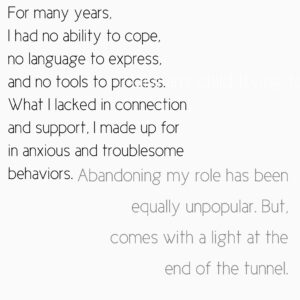
I emerged from that environment with few models for self-soothing, compassion, or kindness, and with maladaptive ways of coping. I could be unreasonable, highly reactive, and say deeply hurtful things. I do not need to minimize any of that to understand where some of those patterns were formed, or to recognize how much I have been able to unlearn and change outside the relationships in which they were shaped and reinforced.

Part of that growth has been learning to identify and intentionally choose something different from the kinds of personalities and relational patterns I had come to associate with what was normal, loving, kind, or healthy. I am still working on not mistaking familiarity for safety or connection.