Wholesome Badass

A Work in Progress — Healing from All the Things​

Wholesome Badass girl draws a new relational blueprint based on nurturing, honest communication, accountability, and trust, while discarding an old blueprint of scapegoating, manipulation, and emotional neglect.

The Caller Was Inside the House

The people I relied on for protection were the same people I needed protection from. They were also the ones teaching lil baby Magda about herself, relationships, and the world. And so she gravitated toward relational patterns imprinted on her lil nervous system long before she could recognize or question them. Always reaching for the emotionally inaccessible archetype… She loved these people and wanted their approval, affection, and inclusion. They were her models for love, conflict, emotional regulation, and accountability. She mimicked some of their harmful behaviors, too. For how could she reject a model she hadn’t yet learned to recognize? I can share how Lil Baby Magda was harmed without asserting I, Big Magda, never caused harm. I own my unwholesome and misguided contributions without accepting responsibility for how others behaved. My first blueprint of the world was emotional instability, chaotic relationships, and illegible, amorphous rules and codes. My internal blueprint developed in response: my lens for perception, beliefs, vigilance, expectations, sense of worth, and capacity to care for myself, regulate my emotions and live with intention and dignity. Life might have been confusing even in a nurturing, steady family system. I might always have required more clarity, consistency, patience, and support. I lost decades tangled up in what the fuck had just happened and why, while forecasting what else would go wrong. What did I do? What did they mean? What did I miss? How do I keep it from happening again? Even when nothing was happening, I was still agonizing over things said and done years earlier. All that attention and energy spent trying to understand and prevent harm left no bandwidth to experience my own life. How much of what I’ve believed about my personality, character, worthiness, and lovability came from the people who taught me how to be a person? What might I have achieved if I hadn’t spent my life trying to figure out what was wrong with me? The messaging was consistent, collective, and insidious: Get different or be erased. If I was the designated problem and couldn’t correct myself, what was left? I couldn’t get different. I couldn’t get gone. I failed at both. And now I’m beginning to see a third way. Finally, I am getting different—not by correcting myself to fit the original blueprint, but by rejecting it.

Read More
Wholesome Badass girl imagines herself drawing a winding path toward a yellow sunrise beneath a calming blue sky.

Who am I when my life is no longer organized around survival?

1. Identity — Who am I without the struggle? 2. Agency — The difference between reacting and initiating 3. The nervous system — When peace is unfamiliar 4. Desire — Discovering what I actually want 5. Dignity — Beyond defending my worth 6. Relationships — Connection without a role to perform 7. The future — A life that isn’t a response to the past Who might I get to be when my choices are guided by curiosity, desire, and intention rather than adaptation and self-protection?

Read More
A woman in Japan reacting with surprise and joy as a Japanese woman bows respectfully to her.

What I Thought Was Normal

I can’t help but laugh in disbelief as I recall my initial encounter of Japan. I seriously took the bowing personally. Not joking. I was 22, and not an all an adult. My understanding of respect, deference, and what people were entitled to take from one another was impossibly distorted. What I experienced as exceptional “kindness” was, in many ways, ordinary cultural respect. How could I have known? I do not recall behavioral models for respect and kindness. I was witness to only varied posturing, which was baffling and not at all intuitive for me. And no system with which to engage and demonstrate high regard for others. Just like weird reverence and what I would now call coercive abuse. A New Way to Relate For much of my life, the only familiar relational dynamic was binary: power over or be powered over. I saw rare others (like unicorns) living with more ease, mutuality, and peace, but that seemed remote. I knew only the system I had been brought up with. And if I had to choose from the menu of options I understood, I definitely believed it preferable to be on the giving end of the abuse because I equated that with authority and rightness. In recognizing and unlearning harmful patterns, I am also staring head-on at the ways I engaged and contributed. I had internalized the belief that how others treated me was information about who I was and what I deserved, and so learned to try and excuse my own harmful behavior by charging it to someone else…like my reaction to them was reflective of ONLY them. I could make no sense of why relationships hurt so much and why connection seemed synonymous with struggle. Looking back, of course it was miserable. If the only options were intimidation or submission, there was no room for flow, cohesion, or safety. And I am actually an avid fan of submission and surrender, but only with those who can be trusted on the other side of that dynamic—more harmony and collaboration than coercion. I have been utterly shocked to learn that some things can be familiar, common, and still symptomatic of unwellness. What feels pivotal is seeing both directions clearly: the harm done to me, and the harm I learned to repeat and then to end. I am deeply pained and regret the harm I learned to absorb, carry, and then offload onto other people. I understand more now, and I live differently, but understanding does not undo impact. Still—so much fkn unlearning. Reparenting yourself at 60 is a lot. What did you once think was normal and acceptable that you now view differently?

Read More
Illustration of a queen in an ornate palace while a woman pulls back a curtain revealing rats hidden behind it.

Love, As I Understand It

In my unlearning — and in forming an understanding of the kinds of love and energy that make sense and feel safe to me — I am having to unlearn a lot of the scary love that shaped me into someone who both accepted and offered scary love. In the love (the verb) that I am now learning, the thing I refer to as “badass love” – sacrifices for others. It does not sacrifice others for any reason. While wholesome love is safe, steady, and nourishing, badass love is that same love under pressure — willing to take a stand, risk vulnerability, and accept the responsibility that comes with having power, influence, or status. Because having the ability to choose differently matters. Badass love has grit. I understand it as healthy love capable of tolerating difficulty without sacrificing dignity, honesty, or another person’s humanity. It is merciful — refusing to leverage status or rightness as a weapon. Badass Love Has Grit I have witnessed badass love in remarkably unremarkable things. Doing a kind thing when nobody will know you did it. Helping when helping is inconvenient and opting out would be preferable. Accepting some discomfort, delay, or less for yourself so someone else can have what they need. Continuing to show up in service when there is no praise coming, no acknowledgment, perhaps not even gratitude. Doing something useful for someone without keeping the receipt for a future argument. Taking a relational risk because healing matters. Being more willing to absorb the cost of doing what feels loving -than to collect credit for having done it. And maybe that is where love reveals the most about itself: when something prized is threatened by what is true. When the status quo could be easily sustained if one person were simply eliminated from it. Evidence of Love For me, love cannot live only in the explanation someone gives for their behavior. Love has to show up in what they are willing to do to another human being in order to remain right or have their way. I keep coming back to something much less romantic: Love is a verb, not a fucking feeling or an intention. Calling something loving does not make it so. Love and character seem well reflected in how much collateral damage a person is willing to cause or accept in defense of their position.  I am all for wholesome badass love. Apparently, it is not for everyone. Have you ever known someone who felt completely certain of their own rightness and entitlement while also understanding themselves as deeply loving? I am certainly no expert, but I have a hard time seeing deep entitlement as a loving posture. Naahmsaaayyyin?

Read More
doesn’t.

What Wholesome Love Looks Like

I’ve been reading about relationships—attachment, avoidance, conflict, repair, deflection, ego, intimacy. And I am noting things that feel true to me. Not rules. Not credentials I suddenly possess. Just observations about the habits and behaviors that seem to accompany loving relationships—and that sometimes stand in stark contrast to what I have known. Things like: Habits and Behaviors of Wholesome Love Loving people don’t want to hurt you. And when they do, they are interested in what happened, how it affected you, and what is needed of them. Loving people can appreciate your joy when they aren’t the source of it. They can be interested in what matters to you even when the thing itself doesn’t particularly interest them. They don’t experience your success as threatening, inconsequential, or unworthy of acknowledgment. They can sit beside frustration, disappointment, or despair they cannot fix without needing those feelings to go away so they can be comfortable again. They can hear, “That hurt me,” without automatically translating it into, “You are a terrible person.” They can be deeply interested in their impact even when they are certain of their intent. They can hold two things at once: I didn’t mean to hurt you and you were hurt by what I did. They don’t ask you to name a time, then punish you for bringing up the past when you do. They don’t move the conversation from what happened to what is wrong with you for being affected by what happened. They don’t use your reaction to deflect from the thing you were reacting to. They can be wrong without needing someone else to be wronger. They don’t require agreement before your experience is worthy of consideration. They don’t punish honesty and then seem confused when you stop talking. They don’t repeatedly teach you that bringing them one problem will leave you with two. They don’t call the absence of conflict peace when one person has simply learned that speaking costs too much. They don’t require you to abandon your own perception in order to remain close to them. They don’t need their understanding of themselves to outrank your experience of them. They participate in repair. They remain curious about you. And maybe that is the thing I am noticing most. It is easy to feel loving when nothing about the other person is difficult for you. I am becoming much more interested in what happens when it is. These are some of the things I am beginning to recognize as wholesome love. What Wholesome Love Doesn’t Do And there are some things I believe, as a standard, loving people don’t do. They don’t lie to you or deliberately deceive you. They don’t hide things you have a right to know or withhold information that affects you. They don’t entertain other people in ways that betray you or your relationship. They don’t ridicule, mock, or call you names. They don’t join other people in disrespecting you or stand comfortably by while it happens. They don’t intimidate you. They don’t deliberately make you feel small, afraid, alone, or outside. They don’t take pleasure in your pain. They don’t manipulate situations to protect themselves at your expense. They don’t rewrite what they said or did once it has upset you. They don’t make you pay for knowing or saying something they would rather you didn’t know or say. They don’t use what you love, fear, need, or have trusted them with against you. They don’t make cruelty acceptable because they were angry. They don’t make betrayal acceptable because they were unhappy. They dont punish you. And call it a natural consequence. They don’t require your confusion for their story to work. And they don’t repeatedly leave you wondering whether you matter to them at all. I guess, if I were to be succinct: loving people lift others up. Not just people they wish to impress or need something from. Just people. They don’t break others down. What would you add about what wholesome love does—and doesn’t do?

Read More
Cartoon-style black-and-white drawing on a soft green background of a girl feeding papers labeled trauma, confusion, misinformation, doubt, and shame into a machine labeled “Processing Through Writing.” Papers coming out say agency, discernment, and intention. Her bag has a small WBA heart logo, and the image is watermarked with wholesomebadass.com.

The Shit Before the Shift

No Dimmer Switch I feel everything the most amount—the good and the unpleasant—constantly. Everything in high definition. I am a deep feeler, or as the archetype likes to say: thin-skinned, overly sensitive. Not a crime. Not a defect. But not an easy way to be in the world. From my tiniest days, I recall feeling inconsolably rattled, navigating my tightly wound nervous system and sensitive disposition with no guidance, knowledge, language, or skill set for any of it. I cannot recall another version of myself underneath it all – who ever felt secure, grounded, safe, and not overwhelmed. That has been my baseline. It is not a great point of departure. Billed to Me I was raised to believe that other people’s harsh behavior spoke directly to the quality of my person, my character, and my worth. Which was terribly confusing, because I was also often scolded for asking if a person was upset with me, “Not everything is about you.” And yet other people’s unfavorable moods and behaviors were consistently billed to me or altogether denied. So… difficult moods and feelings—mine and theirs—were my responsibility. And no clue how to manage that. Painfully aware: I was constantly and undeniably failing. While nobody taught or encouraged me to know, soothe, value, or care for myself, I was expected to read, anticipate, prevent, and manage other people’s difficult feelings. So many times, blood relatives would demand in a menacing tone, “What are you so angry about?” But it was not a genuine inquiry. It was a callout: look at you, with that massive chink in your armor. Feel ashamed and pipe down or else. There is real sadness in looking back and realizing how much unmanaged, daily compounded stress was attributed exclusively to my “poor character.” I spent more than forty years trying to do the impossible thing of getting different and becoming someone else. My only ambition. What a tragic fucken waste. Stripped of any potential to self-actualize. The Familiar And having been been handled like a piece of literal shit—a poopy diaper—I did not instinctively seek nourishing and affirming relationships. I had learned that love looked like people who genuinely were not FOR me—unless and only when I was useful to them. This explains so much. At many levels, I believe the only thing I shared in common with my family of origin was that we all held me in the lowest regard. That is hard to reconcile. And tragically, my only direction was toward the familiar. Ooof. Decades of trying to feel better, by any means possible, without really knowing what I was trying to feel better from. From being a shiftless piece of shit?? There is literally no relief from that. I mistook random positive intermittent reinforcement for kindness and brought that out into the world with me as the love I sought. And sometimes the love I gave. I hate that. Better Information I am proud to have interrupted that cycle, that I did not hand that poison directly to my sons. No matter what is said about me, it cannot be denied that I rode faithfully for my children. Without exception. Maybe not perfectly or without pain to them, but with fierce loyalty and constant sacrifice. In learning about trauma and nervous systems. Neglect. Generational abuse. Coercive abuse. Scapegoating. Triangulation. Attachment, fear, compulsion. I recognize how I confused what was recognizable with what was safe and acceptable. For and from myself. Agency With better information now, I get to experience something that for so long eluded me: agency—where I carefully consider who, what, how, and when to engage, and whether engagement is even required or prudent. Writing helps me recognize and organize all of the me’s inside of me—with no intent to prosecute my past or acquit any of my me’s. I work tirelessly to untangle my myths and misconceptions about myself, love, connection, and kindness. It is a true miracle to have grown into the loving, honest, dependable, funny, compassionate, and loyal woman I am. And this is also true: I have not always known how to move in these ways—or how to move with people who equally value them. First the unlearning. The shit before the shift, I guess. What were you led to believe about yourself because of the way someone else treated you? And do you still belive it?

Read More
Black-and-white cartoon of Wholesome Badass in a jujutsu stance, holding up a glowing shield against dark arrows and scribbles. A speech bubble says, “But here’s what also happened.”

The Power of an Incomplete Truth

In my tagline, I reveal myself as navigating the storm of neurodivergence, trauma, and toxic family systems. For the archetypes with whom I have navigated strife or rupture, I imagine this perspective may feel unwelcome because it adds context to a much simpler explanation: I was just bad. Difficult. Crazy. Selfish. Unreasonable. Context provides nuance that the simpler explanation leaves out. Whatever may have been said or done to diminish me was charged to me: I caused it, deserved it, exaggerated it, or imagined it. The tagline isn’t an attempt to excuse myself, but the closest language I have found for an experience I spent decades unable to articulate. Naming neurodivergence, trauma, and a dysfunctional family system does not make every choice I have ever made harmless, good, or right. It allows nuance into a story where my context was effectively disregarded. And I can’t help but ask, in all earnestness: if my “craziness” was the explanation for every instance of hardship for me, why wasn’t anyone’s response concern, curiosity, or support? What I am chasing is not agreement but a fuller record. More of what actually happened allowed into the room. Other people’s explanations have passed for the complete story, while mine were categorically rejected as inadmissible. If I asked questions, I was manufacturing chaos. If I offered context, I was making excuses. If I remembered something differently, I was rewriting history. I was seeking a clean signal—clarity, cohesion, some way to sew the pieces together for a story that makes sense, even if what emerged was painful or unflattering to me. Apparently, asking clarifying questions seems to threaten the prescribed narrative. Providing context is recieved as equally troublesome. So I am left trying to make sense of a story I was expected to accept, while relevant context was not allowed into consideration. Have you ever realized that what seemed like the only obvious conclusion was actually inaccurate and deeply unfair — once you had a more complete account of the story? One real-life example: I’m in a hurry and stuck behind a man in a posh new Jaguar, stopped in the road and holding up traffic for what I assume is no good reason—just entitled and inconsiderate. Then I SEE he has gotten out of his car to help a disabled elderly person with a heavy package cross the street. Nothing about the stopped car changed. The context did. I feel some of that same aha humbling energy when I think about people like Howard Stern, Monica Lewinsky, Stormy Daniels, Pamela Anderson, and others whom I experienced through a particular public narrative without bothering to question what might have been missing from it. Sometimes the framing was profitable. Sometimes powerful people had an enormous stake in which version prevailed. Either way, I accepted a conclusion before I had much interest in the fuller record. Just saaaaayin.

Read More
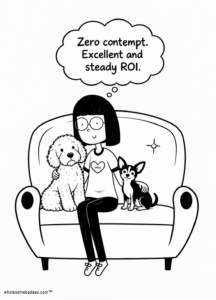
Black-and-white cartoon of a girl with glasses sitting on a couch between a fluffy white dog and a small black dog. A thought bubble above her says, “Zero contempt. Excellent and steady ROI.” The image includes the watermark wholesomebadass.com.

Attachment Without Connection

I have been circling the relationship between attachment, connection, and repair. I understand now how it is possible for me to feel deeply—and painfully—attached to someone and still have no genuine access: the unbearable absence of mutual kindness, curiosity, emotional access, or even respect. I have wasted an enormous energy suffering inside relationships I was desperate to redeem. Situationships that, in retrospect, may have been enmeshment, transactional, or convenient in some way. Not balanced or founded on shared high regard for one another. Too fragile for depth and difficulty. Years of unaddressed friction become suffocating, ending in an unnamed rupture never to be met with repair. Irredeemable. Relational repair simply cannot be achieved by me alone. When a person has adopted an air of contempt, good-faith resolution is unlikely. When they feel so fucking right and righteous that they cannot even look upon me with kindness, my experience and effort carry no weight because the larger conclusion has already been reached about who I am. The archetypal system demands one right and one wrong, snuffing out the possibility of peaceful resolution with mutual intent. More effort by me only creates more suffering. There is literally zero ROI. And this is where I get to examining surrender and resignation. Resignation is apathy or indifference, like: Fuck it. I am done and don’t care. Surrender is a spiritual practice and a choice with agency, dignity, and even peace. Like… This matters to me. I wish it were different. I love you. And I am no longer going to throw myself at a thing that requires presence and intention from each of us. I have stopped confusing my attachment to someone for evidence that a workable relationship is available. There will always be things I wish I had handled differently and things I might do differently now. I acknowledge my failed efforts: They didn’t go incredibly, but I’m proud of how I tried. I find solace and self-worth in owning that I was imperfect without turning that into justification to continue tryyyyying. I am not abandoning the relationship. Or myself. I am withdrawing fruitless, degrading labor from an outcome that requires another participant. Have you ever caught yourself working tirelessly to salvage or preserve an attachment you had confused for deep, lasting connection—even as the effort brought only suffering and indignity?

Read More
Wholesome Badass girl draws a new relational blueprint based on nurturing, honest communication, accountability, and trust, while discarding an old blueprint of scapegoating, manipulation, and emotional neglect.

The Caller Was Inside the House

The people I relied on for protection were the same people I needed protection from. They were also the ones teaching lil baby Magda about herself, relationships, and the world. And so she gravitated toward relational patterns imprinted on her lil nervous system long before she could recognize or question them. Always reaching for the emotionally inaccessible archetype… She loved these people and wanted their approval, affection, and inclusion. They were her models for love, conflict, emotional regulation, and accountability. She mimicked some of their harmful behaviors, too. For how could she reject a model she hadn’t yet learned to recognize? I can share how Lil Baby Magda was harmed without asserting I, Big Magda, never caused harm. I own my unwholesome and misguided contributions without accepting responsibility for how others behaved. My first blueprint of the world was emotional instability, chaotic relationships, and illegible, amorphous rules and codes. My internal blueprint developed in response: my lens for perception, beliefs, vigilance, expectations, sense of worth, and capacity to care for myself, regulate my emotions and live with intention and dignity. Life might have been confusing even in a nurturing, steady family system. I might always have required more clarity, consistency, patience, and support. I lost decades tangled up in what the fuck had just happened and why, while forecasting what else would go wrong. What did I do? What did they mean? What did I miss? How do I keep it from happening again? Even when nothing was happening, I was still agonizing over things said and done years earlier. All that attention and energy spent trying to understand and prevent harm left no bandwidth to experience my own life. How much of what I’ve believed about my personality, character, worthiness, and lovability came from the people who taught me how to be a person? What might I have achieved if I hadn’t spent my life trying to figure out what was wrong with me? The messaging was consistent, collective, and insidious: Get different or be erased. If I was the designated problem and couldn’t correct myself, what was left? I couldn’t get different. I couldn’t get gone. I failed at both. And now I’m beginning to see a third way. Finally, I am getting different—not by correcting myself to fit the original blueprint, but by rejecting it.

Read More
Wholesome Badass girl imagines herself drawing a winding path toward a yellow sunrise beneath a calming blue sky.

Who am I when my life is no longer organized around survival?

1. Identity — Who am I without the struggle? 2. Agency — The difference between reacting and initiating 3. The nervous system — When peace is unfamiliar 4. Desire — Discovering what I actually want 5. Dignity — Beyond defending my worth 6. Relationships — Connection without a role to perform 7. The future — A life that isn’t a response to the past Who might I get to be when my choices are guided by curiosity, desire, and intention rather than adaptation and self-protection?

Read More
A woman in Japan reacting with surprise and joy as a Japanese woman bows respectfully to her.

What I Thought Was Normal

I can’t help but laugh in disbelief as I recall my initial encounter of Japan. I seriously took the bowing personally. Not joking. I was 22, and not an all an adult. My understanding of respect, deference, and what people were entitled to take from one another was impossibly distorted. What I experienced as exceptional “kindness” was, in many ways, ordinary cultural respect. How could I have known? I do not recall behavioral models for respect and kindness. I was witness to only varied posturing, which was baffling and not at all intuitive for me. And no system with which to engage and demonstrate high regard for others. Just like weird reverence and what I would now call coercive abuse. A New Way to Relate For much of my life, the only familiar relational dynamic was binary: power over or be powered over. I saw rare others (like unicorns) living with more ease, mutuality, and peace, but that seemed remote. I knew only the system I had been brought up with. And if I had to choose from the menu of options I understood, I definitely believed it preferable to be on the giving end of the abuse because I equated that with authority and rightness. In recognizing and unlearning harmful patterns, I am also staring head-on at the ways I engaged and contributed. I had internalized the belief that how others treated me was information about who I was and what I deserved, and so learned to try and excuse my own harmful behavior by charging it to someone else…like my reaction to them was reflective of ONLY them. I could make no sense of why relationships hurt so much and why connection seemed synonymous with struggle. Looking back, of course it was miserable. If the only options were intimidation or submission, there was no room for flow, cohesion, or safety. And I am actually an avid fan of submission and surrender, but only with those who can be trusted on the other side of that dynamic—more harmony and collaboration than coercion. I have been utterly shocked to learn that some things can be familiar, common, and still symptomatic of unwellness. What feels pivotal is seeing both directions clearly: the harm done to me, and the harm I learned to repeat and then to end. I am deeply pained and regret the harm I learned to absorb, carry, and then offload onto other people. I understand more now, and I live differently, but understanding does not undo impact. Still—so much fkn unlearning. Reparenting yourself at 60 is a lot. What did you once think was normal and acceptable that you now view differently?

Read More
Illustration of a queen in an ornate palace while a woman pulls back a curtain revealing rats hidden behind it.

Love, As I Understand It

In my unlearning — and in forming an understanding of the kinds of love and energy that make sense and feel safe to me — I am having to unlearn a lot of the scary love that shaped me into someone who both accepted and offered scary love. In the love (the verb) that I am now learning, the thing I refer to as “badass love” – sacrifices for others. It does not sacrifice others for any reason. While wholesome love is safe, steady, and nourishing, badass love is that same love under pressure — willing to take a stand, risk vulnerability, and accept the responsibility that comes with having power, influence, or status. Because having the ability to choose differently matters. Badass love has grit. I understand it as healthy love capable of tolerating difficulty without sacrificing dignity, honesty, or another person’s humanity. It is merciful — refusing to leverage status or rightness as a weapon. Badass Love Has Grit I have witnessed badass love in remarkably unremarkable things. Doing a kind thing when nobody will know you did it. Helping when helping is inconvenient and opting out would be preferable. Accepting some discomfort, delay, or less for yourself so someone else can have what they need. Continuing to show up in service when there is no praise coming, no acknowledgment, perhaps not even gratitude. Doing something useful for someone without keeping the receipt for a future argument. Taking a relational risk because healing matters. Being more willing to absorb the cost of doing what feels loving -than to collect credit for having done it. And maybe that is where love reveals the most about itself: when something prized is threatened by what is true. When the status quo could be easily sustained if one person were simply eliminated from it. Evidence of Love For me, love cannot live only in the explanation someone gives for their behavior. Love has to show up in what they are willing to do to another human being in order to remain right or have their way. I keep coming back to something much less romantic: Love is a verb, not a fucking feeling or an intention. Calling something loving does not make it so. Love and character seem well reflected in how much collateral damage a person is willing to cause or accept in defense of their position.  I am all for wholesome badass love. Apparently, it is not for everyone. Have you ever known someone who felt completely certain of their own rightness and entitlement while also understanding themselves as deeply loving? I am certainly no expert, but I have a hard time seeing deep entitlement as a loving posture. Naahmsaaayyyin?

Read More
doesn’t.

What Wholesome Love Looks Like

I’ve been reading about relationships—attachment, avoidance, conflict, repair, deflection, ego, intimacy. And I am noting things that feel true to me. Not rules. Not credentials I suddenly possess. Just observations about the habits and behaviors that seem to accompany loving relationships—and that sometimes stand in stark contrast to what I have known. Things like: Habits and Behaviors of Wholesome Love Loving people don’t want to hurt you. And when they do, they are interested in what happened, how it affected you, and what is needed of them. Loving people can appreciate your joy when they aren’t the source of it. They can be interested in what matters to you even when the thing itself doesn’t particularly interest them. They don’t experience your success as threatening, inconsequential, or unworthy of acknowledgment. They can sit beside frustration, disappointment, or despair they cannot fix without needing those feelings to go away so they can be comfortable again. They can hear, “That hurt me,” without automatically translating it into, “You are a terrible person.” They can be deeply interested in their impact even when they are certain of their intent. They can hold two things at once: I didn’t mean to hurt you and you were hurt by what I did. They don’t ask you to name a time, then punish you for bringing up the past when you do. They don’t move the conversation from what happened to what is wrong with you for being affected by what happened. They don’t use your reaction to deflect from the thing you were reacting to. They can be wrong without needing someone else to be wronger. They don’t require agreement before your experience is worthy of consideration. They don’t punish honesty and then seem confused when you stop talking. They don’t repeatedly teach you that bringing them one problem will leave you with two. They don’t call the absence of conflict peace when one person has simply learned that speaking costs too much. They don’t require you to abandon your own perception in order to remain close to them. They don’t need their understanding of themselves to outrank your experience of them. They participate in repair. They remain curious about you. And maybe that is the thing I am noticing most. It is easy to feel loving when nothing about the other person is difficult for you. I am becoming much more interested in what happens when it is. These are some of the things I am beginning to recognize as wholesome love. What Wholesome Love Doesn’t Do And there are some things I believe, as a standard, loving people don’t do. They don’t lie to you or deliberately deceive you. They don’t hide things you have a right to know or withhold information that affects you. They don’t entertain other people in ways that betray you or your relationship. They don’t ridicule, mock, or call you names. They don’t join other people in disrespecting you or stand comfortably by while it happens. They don’t intimidate you. They don’t deliberately make you feel small, afraid, alone, or outside. They don’t take pleasure in your pain. They don’t manipulate situations to protect themselves at your expense. They don’t rewrite what they said or did once it has upset you. They don’t make you pay for knowing or saying something they would rather you didn’t know or say. They don’t use what you love, fear, need, or have trusted them with against you. They don’t make cruelty acceptable because they were angry. They don’t make betrayal acceptable because they were unhappy. They dont punish you. And call it a natural consequence. They don’t require your confusion for their story to work. And they don’t repeatedly leave you wondering whether you matter to them at all. I guess, if I were to be succinct: loving people lift others up. Not just people they wish to impress or need something from. Just people. They don’t break others down. What would you add about what wholesome love does—and doesn’t do?

Read More
Cartoon-style black-and-white drawing on a soft green background of a girl feeding papers labeled trauma, confusion, misinformation, doubt, and shame into a machine labeled “Processing Through Writing.” Papers coming out say agency, discernment, and intention. Her bag has a small WBA heart logo, and the image is watermarked with wholesomebadass.com.

The Shit Before the Shift

No Dimmer Switch I feel everything the most amount—the good and the unpleasant—constantly. Everything in high definition. I am a deep feeler, or as the archetype likes to say: thin-skinned, overly sensitive. Not a crime. Not a defect. But not an easy way to be in the world. From my tiniest days, I recall feeling inconsolably rattled, navigating my tightly wound nervous system and sensitive disposition with no guidance, knowledge, language, or skill set for any of it. I cannot recall another version of myself underneath it all – who ever felt secure, grounded, safe, and not overwhelmed. That has been my baseline. It is not a great point of departure. Billed to Me I was raised to believe that other people’s harsh behavior spoke directly to the quality of my person, my character, and my worth. Which was terribly confusing, because I was also often scolded for asking if a person was upset with me, “Not everything is about you.” And yet other people’s unfavorable moods and behaviors were consistently billed to me or altogether denied. So… difficult moods and feelings—mine and theirs—were my responsibility. And no clue how to manage that. Painfully aware: I was constantly and undeniably failing. While nobody taught or encouraged me to know, soothe, value, or care for myself, I was expected to read, anticipate, prevent, and manage other people’s difficult feelings. So many times, blood relatives would demand in a menacing tone, “What are you so angry about?” But it was not a genuine inquiry. It was a callout: look at you, with that massive chink in your armor. Feel ashamed and pipe down or else. There is real sadness in looking back and realizing how much unmanaged, daily compounded stress was attributed exclusively to my “poor character.” I spent more than forty years trying to do the impossible thing of getting different and becoming someone else. My only ambition. What a tragic fucken waste. Stripped of any potential to self-actualize. The Familiar And having been been handled like a piece of literal shit—a poopy diaper—I did not instinctively seek nourishing and affirming relationships. I had learned that love looked like people who genuinely were not FOR me—unless and only when I was useful to them. This explains so much. At many levels, I believe the only thing I shared in common with my family of origin was that we all held me in the lowest regard. That is hard to reconcile. And tragically, my only direction was toward the familiar. Ooof. Decades of trying to feel better, by any means possible, without really knowing what I was trying to feel better from. From being a shiftless piece of shit?? There is literally no relief from that. I mistook random positive intermittent reinforcement for kindness and brought that out into the world with me as the love I sought. And sometimes the love I gave. I hate that. Better Information I am proud to have interrupted that cycle, that I did not hand that poison directly to my sons. No matter what is said about me, it cannot be denied that I rode faithfully for my children. Without exception. Maybe not perfectly or without pain to them, but with fierce loyalty and constant sacrifice. In learning about trauma and nervous systems. Neglect. Generational abuse. Coercive abuse. Scapegoating. Triangulation. Attachment, fear, compulsion. I recognize how I confused what was recognizable with what was safe and acceptable. For and from myself. Agency With better information now, I get to experience something that for so long eluded me: agency—where I carefully consider who, what, how, and when to engage, and whether engagement is even required or prudent. Writing helps me recognize and organize all of the me’s inside of me—with no intent to prosecute my past or acquit any of my me’s. I work tirelessly to untangle my myths and misconceptions about myself, love, connection, and kindness. It is a true miracle to have grown into the loving, honest, dependable, funny, compassionate, and loyal woman I am. And this is also true: I have not always known how to move in these ways—or how to move with people who equally value them. First the unlearning. The shit before the shift, I guess. What were you led to believe about yourself because of the way someone else treated you? And do you still belive it?

Read More
Black-and-white cartoon of Wholesome Badass in a jujutsu stance, holding up a glowing shield against dark arrows and scribbles. A speech bubble says, “But here’s what also happened.”

The Power of an Incomplete Truth

In my tagline, I reveal myself as navigating the storm of neurodivergence, trauma, and toxic family systems. For the archetypes with whom I have navigated strife or rupture, I imagine this perspective may feel unwelcome because it adds context to a much simpler explanation: I was just bad. Difficult. Crazy. Selfish. Unreasonable. Context provides nuance that the simpler explanation leaves out. Whatever may have been said or done to diminish me was charged to me: I caused it, deserved it, exaggerated it, or imagined it. The tagline isn’t an attempt to excuse myself, but the closest language I have found for an experience I spent decades unable to articulate. Naming neurodivergence, trauma, and a dysfunctional family system does not make every choice I have ever made harmless, good, or right. It allows nuance into a story where my context was effectively disregarded. And I can’t help but ask, in all earnestness: if my “craziness” was the explanation for every instance of hardship for me, why wasn’t anyone’s response concern, curiosity, or support? What I am chasing is not agreement but a fuller record. More of what actually happened allowed into the room. Other people’s explanations have passed for the complete story, while mine were categorically rejected as inadmissible. If I asked questions, I was manufacturing chaos. If I offered context, I was making excuses. If I remembered something differently, I was rewriting history. I was seeking a clean signal—clarity, cohesion, some way to sew the pieces together for a story that makes sense, even if what emerged was painful or unflattering to me. Apparently, asking clarifying questions seems to threaten the prescribed narrative. Providing context is recieved as equally troublesome. So I am left trying to make sense of a story I was expected to accept, while relevant context was not allowed into consideration. Have you ever realized that what seemed like the only obvious conclusion was actually inaccurate and deeply unfair — once you had a more complete account of the story? One real-life example: I’m in a hurry and stuck behind a man in a posh new Jaguar, stopped in the road and holding up traffic for what I assume is no good reason—just entitled and inconsiderate. Then I SEE he has gotten out of his car to help a disabled elderly person with a heavy package cross the street. Nothing about the stopped car changed. The context did. I feel some of that same aha humbling energy when I think about people like Howard Stern, Monica Lewinsky, Stormy Daniels, Pamela Anderson, and others whom I experienced through a particular public narrative without bothering to question what might have been missing from it. Sometimes the framing was profitable. Sometimes powerful people had an enormous stake in which version prevailed. Either way, I accepted a conclusion before I had much interest in the fuller record. Just saaaaayin.

Read More
Black-and-white cartoon of a girl with glasses sitting on a couch between a fluffy white dog and a small black dog. A thought bubble above her says, “Zero contempt. Excellent and steady ROI.” The image includes the watermark wholesomebadass.com.

Attachment Without Connection

I have been circling the relationship between attachment, connection, and repair. I understand now how it is possible for me to feel deeply—and painfully—attached to someone and still have no genuine access: the unbearable absence of mutual kindness, curiosity, emotional access, or even respect. I have wasted an enormous energy suffering inside relationships I was desperate to redeem. Situationships that, in retrospect, may have been enmeshment, transactional, or convenient in some way. Not balanced or founded on shared high regard for one another. Too fragile for depth and difficulty. Years of unaddressed friction become suffocating, ending in an unnamed rupture never to be met with repair. Irredeemable. Relational repair simply cannot be achieved by me alone. When a person has adopted an air of contempt, good-faith resolution is unlikely. When they feel so fucking right and righteous that they cannot even look upon me with kindness, my experience and effort carry no weight because the larger conclusion has already been reached about who I am. The archetypal system demands one right and one wrong, snuffing out the possibility of peaceful resolution with mutual intent. More effort by me only creates more suffering. There is literally zero ROI. And this is where I get to examining surrender and resignation. Resignation is apathy or indifference, like: Fuck it. I am done and don’t care. Surrender is a spiritual practice and a choice with agency, dignity, and even peace. Like… This matters to me. I wish it were different. I love you. And I am no longer going to throw myself at a thing that requires presence and intention from each of us. I have stopped confusing my attachment to someone for evidence that a workable relationship is available. There will always be things I wish I had handled differently and things I might do differently now. I acknowledge my failed efforts: They didn’t go incredibly, but I’m proud of how I tried. I find solace and self-worth in owning that I was imperfect without turning that into justification to continue tryyyyying. I am not abandoning the relationship. Or myself. I am withdrawing fruitless, degrading labor from an outcome that requires another participant. Have you ever caught yourself working tirelessly to salvage or preserve an attachment you had confused for deep, lasting connection—even as the effort brought only suffering and indignity?

Read More