Wholesome Badass

A Work in Progress — Healing from All the Things​

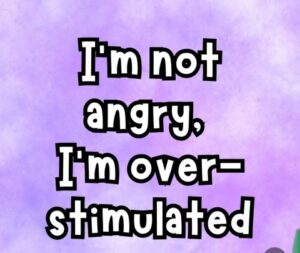
Text image with the words: “I am not angry. I am overstimulated.” Indicates that emotional reactions may reflect overwhelm, not anger.

Defiance or Distress

I do not seem naturally wired to preserve “harmony” by pretending not to see what I see and not feel what I feel. It is not as if everyone is having roughly the same experience and others make the more agreeable decision to go with the flow while I make the objectionable decision to diverge, which gets me branded not as divergent but deviant. Difficult to govern gets conflated with untrustworthy and unworthy. Not a team player. I simply cannot go with a flow that feels wildly dysregulating. My nervous system picks up and responds to things that either do not hit other people’s radar at all or do not register with anything close to the same intensity. It is not unlike some version of a dog whistle. We can be in the same room, inside the same system, and not be receiving the same input or impact from it. If something barely bothers a person, accommodating it will require little of them—nothing to resist or mask. They can easily carry on, genuinely unaffected. If the same thing is creating unmanageable discomfort in me, going along can leave me completely taxed. My depletion gets read as attitude. And yet the person who can comfortably accommodate is regarded as flexible and cooperative—which may not be untrue. But the converse about me is not necessarily true. Yes, I am less easy. But I don’t think less easy is the same as difficult or deviant. So how much of what I have understood as something wrong with me was actually the branding of a person who could not seamlessly abide without a trace a visible strain?

Read More
Rattlesnake wearing a party hat on a pink unicorn bed, symbolizing hidden danger in plain sight.

The Curated Impression

How a Narrative Protects Predatory Behavior The Branding Becomes the Lens I am recognizing something in real time: the story about someone can matter more than what they actually say and do. When someone is characterized unfavorably by a person of greater status or influence, the language is often directed toward creating a shared lens through which others understand them. That version can serve as the starting assumption. Hierarchy gives it weight. This is the branding. The packaging. And it matters who establishes it. From there, a trajectory takes shape. The branding creates two outcomes at once: one person is invalidated while the other is insulated and immune to scrutiny. The branding calls the person to defense, then uses that defense as evidence that the characterization was right. Distress is recast as instability, attempts at clarity as difficulty, withdrawal as withholding, and any strong response as confirmation. Evidence to the contrary is inadmissible. It does not weaken the characterization. This is what makes the role difficult to escape. The arrangement is zero-sum: for one person to remain credible and protected, the other has to remain discredited. This is not a self-fulfilling prophecy in the usual sense because the premise does not originate with the branded one. It is imposed from “above,” then used to interpret everything that follows. Reality gets outranked by narrative. A response can be disproportionate, messy, or wrong without making the underlying experience unreal. Someone can be difficult or unpopular and still have been treated poorly. But the formula reigns: When the conduct of the protected archetype is questioned: Well, I only acted this way because of who and how YOU/THEY are. Have you been in a relationship in which another person’s missteps, poor choices, words, or conduct were repeatedly assigned to something supposedly wrong with you? WTAF? As in: If I behave like an asshole, it is only because you suck.

Read More
Black-and-white cartoon of a woman asking if something is wrong. Another woman denies it, then meets privately with two others to discuss a folder labeled “The Problem With Her.”

What Actually Happened?

The Alchemy of the Unexitable Loop: Someone behaves toward you in bullying, degrading, diminishing, or disruptive ways, then denies it or explains it as a consequence of who you are. Literally: they turn their own behavior into evidence against you. I am wired to sense shifts in energy. I don’t mean that in some mystical way, and I don’t mean that I am being paranoid. I am attuned at a sensory and emotional level to things other people may have the luxury of not noticing. Cold, detached silence. Avoidant eye contact. Being ignored. A change in tone. The almost imperceptible shift from being in connection with someone to being very clearly outside of it. And because nothing had been indicated, I would ask. What’s wrong? Nothing. And the coldness intensified. Naturally I would ask again. So fkn earnest. And now the inquiry itself was the only issue. Suddenly there was something concrete to point to: my questioning. My inability to leave it alone. My insistence that something was wrong when I had been clearly told there wasn’t. And there is the loop. I experienced the tension. I inquired directly. My asking was labeled as escalation. The heightened tension was then used to explain the tension I had originally asked about. Therefore, apparently, I had imagined it. Or caused it. Or manufactured chaos where none had existed. And now my behavior could justify whatever came next. There was no direct confrontation. No, “I’m angry with you.” No, “I didn’t love that.” No, “Can we talk about what happened?” No good-faith request to understand. Not even a simple statement of displeasure. At least not to me. The displeasure was expressed elsewhere, to others. So while insisting that nothing was wrong, an entirely different conversation could be unfolding outside of my participation. Because gossip and triangulation are somehow more dignified and “peace-keeping” than openly addressing friction? There was no opportunity to acknowledge the discord, clarify anything, take responsibility for what was actually mine, or repair the relationship. Instead, the grievance traveled laterally. Triangulation. Gossip. Division. And if it eventually did come directly to me, it wasn’t offered as information that might help us understand each other. It came with teeth, delivered for maximum injury. Not: Here is what landed poorly for me. More: Here is what is wrong with you. There was a negative space where repair should have happened, while a narrative developed without me. By then, the equation was complete. I had detected something I wasn’t supposed to detect. I had asked about something I was told wasn’t happening. My asking was cast as evidence that I had created the problem. And having created the problem, I had apparently earned whatever harmful thing followed. Another person’s harmful reaction gets explained entirely by my character. That’s the alchemy. Have you ever been in a relationship with someone whose coldness you could feel, but when you asked what was wrong, you were told nothing? And asking only made things worse. Whatever happened next was regarded only as the thing you had coming to you. For being this way. Literally: their behavior gets reassigned to your character.

Read More
Black-and-white illustration of a distressed girl telling her mother and sister something hurts. They press buttons producing labels including dramatic, selfish, ungrateful, and too sensitive, leaving comfort and support untouched.

When Distress Is Dismissed as Negativity or Drama

I came into the family as the youngest, with a tightly wound nervous system and a way of taking in the world that was unusually sensitive—to sensory and emotional input, even chemical sensitivity to basic food ingredients. What I recognize now is how easily my frequent, unbridled emotional displays of despair could steal the show. Once I was visibly distressed, the distress itself was identified as the issue. Only in 12-step recovery did I learn to withhold the gift of distraction of my reaction. Before developing the metacognitive ability and language to name what was happening inside me, I certainly failed to make a persuasive case for myself. I have now accessed language for what happened, but no one in my family has shown even remote interest in understanding it—or me. I do not recall being met with curiosity by any single person, about what I was experiencing or what I might need. I remember correction, judgment, banishment, and even mocking by the actual adults. It was as though there was one established way to deal with me. I think of that as the branding. The packaging. The lens through which everything about me was processed. My discomfort, which went unconsoled and therefore persisted and compounded, was treated as evidence that something was fundamentally wrong with me. Dramatic. Histrionic. Too sensitive. Attention-seeking. Always the problem with problems. Over time, the branding hardened into vilification. Definitely an othering. Whatever I was reacting to could disappear behind the reaction. That created an ecosystem in which anything reductive, degrading, hurtful, or upsetting to me could pass without resistance or examination. Whatever else may be true, this is my experience. The branding did not merely shape my understanding of myself and my family. It made harming me easier, more permissible, and more deniable. I emerged from that environment with few models for self-soothing, compassion, or kindness, and with maladaptive ways of coping. I could be unreasonable, highly reactive, and say deeply hurtful things. I do not need to minimize any of that to understand where some of those patterns were formed, or to recognize how much I have unlearned and changed outside the relationships in which they were shaped and reinforced. Part of that growth has been learning to identify and intentionally choose something different from the kinds of personalities and relational patterns I had come to associate with what was normal, loving, kind, or healthy. I am still working on not mistaking familiarity for safety or connection.

Read More
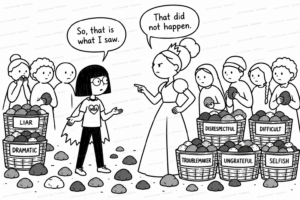
Black-and-white cartoon of a girl describing what she witnessed while a stern woman denies it. Villagers hold baskets of stones labeled liar, dramatic, selfish, ungrateful, and disrespectful, illustrating gaslighting and scapegoating.

Beyond Reproach?

Whatever is said or believed about me does not change what was said and done. I keep coming back to the possibility that the golden child can occupy the position of a protected abuser. So much of my childhood was lost in the shadow of what happened with my female sibling, older than me by 7 years. Decades later, she came for my children. I am only beginning to recognize the correlation between the two. Not identical acts. A familiar code. She acts. I object. My objection is treated as the offense. My experience is displaced. Her version is granted authority. Others are drawn in. Her position remains protected. Mine grows increasingly difficult to hold without defending myself. She was afforded the identity and cover of “good,” while I was named a menace for directly objecting and emotionally reacting to behavior that was, in fact, objectionable by almost any standard. She was able to compromise me in plain sight from behind the protective shield of who everyone believed her to be. It was never-ending. From the outside, it must have looked as if I were crazy—boxing with ghosts. People could see my distress. They could not see the quiet dog whistles, unwanted touching, exclusions, implications, and positioning I was responding to. And I can say now that I was fucking crazed by what was happening—not only because it was harmful, but because the harm was denied and protected. The asymmetry was brutal: one person retained the cover of goodness while my visible distress was treated as if it had appeared out of nowhere- a thing I elected to do. My reaction was indeed spectacular. What preceded it remained invisible. Maybe that is part of what I am processing now. For decades, people must have thought, Yikes. What is wrong with her? I have spent years interrogating that question too. Only recently have I become more interested in a different question: What happened to her, to lil Magda? Why is it easier to ask what is wrong with someone than to ask what happened to them? The first question leaves the existing narrative intact. The second invites examination. It is a fascinating pattern: harm can be easily masked by a role, a reputation, even an act that looks virtuous from across the room. A person can be doing harm while being protected by the belief that they are good. Years later, I would be profoundly affected by a pastor whose attention felt like the most extraordinary care. I can see now how I had been groomed to mistrust my own perception, particularly when harm came through someone occupying a role presumed to be protective—a shepherd, someone understood to be good, trustworthy, and morally authoritative. I keep thinking of the line, “Not all villains wear black.” There is an almost absurd irony in that for me: I tend to dress mostly in black, while my female sibling favors white. hmmmm…. I don’t think clothing color informs us of character, of course. Have you ever watched harmful behavior happen in plain sight while others showed and spoke no objection – maybe because of the status, influence, or authority of the person doing it, or the lesser status of the person being harmed—so that neutrality itself functioned as permission? What is that even called? It reminds me of that scene in Boardwalk Empire where a priest appears to be baptizing a man in front of the entire church. What everyone else sees is a sacred ritual performed by someone occupying one of the most trusted positions in the room. What is actually happening is murder.

Read More
Flames burning a bridge, symbolizing narcissistic family conflict and broken relationships.

Family Betrayal in Plain Sight (repost from 2017)

In 2008, I visited North Carolina for a therapy session with my mother and sister. It went poorly. Tragically. Since, we each showed up with the intent to assess only my behaviors and personality. I miscarried. And that was the least of the devastation. For obvious reasons, I was unable to rally for a neighborhood trick-or-treat parade with my sister and her family. I needed time and space to rest and grieve the tragedy of that session, my family, and the loss of a pregnancy while nursing and caring for my 10-month-old. And was accused of denying my nieces access to their cousin. My 10-year-old niece and I had been emailing and enjoying each other regularly. I would have liked seeing her and her sister under different circumstances. Rather than facing our issues directly, my sister sent a birthday gift addressed to my one-year-old son with a typed note inside telling me not to interact with her girls until we had worked things out as a family. I found it years later while purging for an upcoming move. A declaration of war, not an invitation to peace. The standard response to a boundary or me trying to inhabit my own space. NOTE: The alliance between my sister and my ex was not left over from when we were married. There was no contact or connection while married—we lived on opposite coasts and were estranged. An alliance formed while he and I were struggling as divorced co-parents after what had been a hard-won improvement following our high-conflict divorce. She tried to erase me while accusing me of abandoning family. She divided nieces from their aunt, my mother from me, and increasingly inserted herself into the relationship between my ex-husband and me. My sons witnessed the escalating tension between their mother and father involving her. What they wanted more than anything was the possibility that Mom and Dad could work together and sit together at a meal or occasion. Instead, she fanned the flames of division…… the pattern. All inthe name of her brand of love. I could not pretend. And I cleanly, clearly, and repeatedly presented myself for healing and repair. It was easy to convince me that it was my imagination or my fault without the written record. I do not earn, cause, deserve, or imagine the horror of having been her younger sister. Whatever else may be true, this is my experience.

Read More
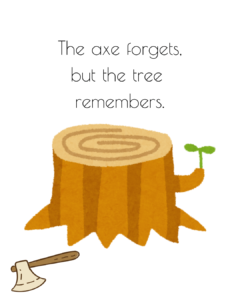
Chopped down tree symbolizing the lasting impact of family betrayal and parental alienation.

How Did We Get Here?

At a very tense Mother’s Day gathering in 2016, I learned that my niece’s graduation was less than four weeks away and on the same night as a concert I had already committed to. The tickets had been a Valentine’s Day gift and the plans had been in place for months. It wasn’t that I chose a concert over her graduation. I simply already had plans by the time I was given the date. With no other way to get my boys to the graduation, and valuing the opportunity for family that being there would give them, I sent them with their dad. Even then, I sensed it could be a fatal choice. Later, my mother told me that while they were at the graduation, plans began for a birthday gathering for my son that would intentionally exclude me. Whatever was happening between the adults, I had directly and repeatedly asked that it stay there, and that we do the work of repair. Something in the fabric of my universe was torn beyond repair. Whatever else may be true, this also happened. I’ve been accused of being negative- always imagining the worst. Maybe I was never imagining the worst. Maybe I’m recognizing and recalling what I have lived. Have you ever been called negative for noticing a pattern that later proved real?

Read More
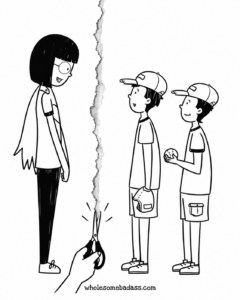
Black-and-white illustration of a mother separated from her two sons by a torn divide, while a hand with scissors cuts between them, symbolizing triangulation and parental alienation.

Paranoia or Pattern Recognition?

Sometimes the most disturbing part of a pattern isn’t what eventually happens. It’s remembering how clearly you could see it taking shape. The small exclusions. The shifting alliances. The selective sharing of information. The quiet rearranging of relationships until someone who once belonged is increasingly treated as an outsider. Each incident, on its own, can be explained away. Questioning the pattern can become a bigger offense than the pattern itself. And when children are involved, I find that especially troubling. I cannot imagine how children benefit from arrangements in which belonging to one relationship gradually comes at the expense of another. What happens when choosing sides becomes so familiar that it no longer feels like choosing? And then there’s the accusation of paranoia. As though recognizing something that has happened repeatedly is the same as inventing something that hasn’t happened at all. How many times does something have to happen before recognizing it is no longer treated as imagining the worst? Or being negative? I remember being asked why I always imagined the worst. I wasn’t imagining. I was recalling. There is a difference between expecting the worst and recognizing something you’ve already lived. And sometimes, years later, you come across something that reminds you just how early you recognized it. Years later, I came across a video I recorded on the morning of my mother’s funeral, after receiving less than 24 hours’ notice of her death and the service. Even then, I was describing what I feared was taking shape and what it might eventually ask of my children. Whatever else may be true, this is what I was seeing, experiencing, and fearing at the time. A recording from that morning.  

Read More
Text image with the words: “I am not angry. I am overstimulated.” Indicates that emotional reactions may reflect overwhelm, not anger.

Defiance or Distress

I do not seem naturally wired to preserve “harmony” by pretending not to see what I see and not feel what I feel. It is not as if everyone is having roughly the same experience and others make the more agreeable decision to go with the flow while I make the objectionable decision to diverge, which gets me branded not as divergent but deviant. Difficult to govern gets conflated with untrustworthy and unworthy. Not a team player. I simply cannot go with a flow that feels wildly dysregulating. My nervous system picks up and responds to things that either do not hit other people’s radar at all or do not register with anything close to the same intensity. It is not unlike some version of a dog whistle. We can be in the same room, inside the same system, and not be receiving the same input or impact from it. If something barely bothers a person, accommodating it will require little of them—nothing to resist or mask. They can easily carry on, genuinely unaffected. If the same thing is creating unmanageable discomfort in me, going along can leave me completely taxed. My depletion gets read as attitude. And yet the person who can comfortably accommodate is regarded as flexible and cooperative—which may not be untrue. But the converse about me is not necessarily true. Yes, I am less easy. But I don’t think less easy is the same as difficult or deviant. So how much of what I have understood as something wrong with me was actually the branding of a person who could not seamlessly abide without a trace a visible strain?

Read More
Rattlesnake wearing a party hat on a pink unicorn bed, symbolizing hidden danger in plain sight.

The Curated Impression

How a Narrative Protects Predatory Behavior The Branding Becomes the Lens I am recognizing something in real time: the story about someone can matter more than what they actually say and do. When someone is characterized unfavorably by a person of greater status or influence, the language is often directed toward creating a shared lens through which others understand them. That version can serve as the starting assumption. Hierarchy gives it weight. This is the branding. The packaging. And it matters who establishes it. From there, a trajectory takes shape. The branding creates two outcomes at once: one person is invalidated while the other is insulated and immune to scrutiny. The branding calls the person to defense, then uses that defense as evidence that the characterization was right. Distress is recast as instability, attempts at clarity as difficulty, withdrawal as withholding, and any strong response as confirmation. Evidence to the contrary is inadmissible. It does not weaken the characterization. This is what makes the role difficult to escape. The arrangement is zero-sum: for one person to remain credible and protected, the other has to remain discredited. This is not a self-fulfilling prophecy in the usual sense because the premise does not originate with the branded one. It is imposed from “above,” then used to interpret everything that follows. Reality gets outranked by narrative. A response can be disproportionate, messy, or wrong without making the underlying experience unreal. Someone can be difficult or unpopular and still have been treated poorly. But the formula reigns: When the conduct of the protected archetype is questioned: Well, I only acted this way because of who and how YOU/THEY are. Have you been in a relationship in which another person’s missteps, poor choices, words, or conduct were repeatedly assigned to something supposedly wrong with you? WTAF? As in: If I behave like an asshole, it is only because you suck.

Read More
Black-and-white cartoon of a woman asking if something is wrong. Another woman denies it, then meets privately with two others to discuss a folder labeled “The Problem With Her.”

What Actually Happened?

The Alchemy of the Unexitable Loop: Someone behaves toward you in bullying, degrading, diminishing, or disruptive ways, then denies it or explains it as a consequence of who you are. Literally: they turn their own behavior into evidence against you. I am wired to sense shifts in energy. I don’t mean that in some mystical way, and I don’t mean that I am being paranoid. I am attuned at a sensory and emotional level to things other people may have the luxury of not noticing. Cold, detached silence. Avoidant eye contact. Being ignored. A change in tone. The almost imperceptible shift from being in connection with someone to being very clearly outside of it. And because nothing had been indicated, I would ask. What’s wrong? Nothing. And the coldness intensified. Naturally I would ask again. So fkn earnest. And now the inquiry itself was the only issue. Suddenly there was something concrete to point to: my questioning. My inability to leave it alone. My insistence that something was wrong when I had been clearly told there wasn’t. And there is the loop. I experienced the tension. I inquired directly. My asking was labeled as escalation. The heightened tension was then used to explain the tension I had originally asked about. Therefore, apparently, I had imagined it. Or caused it. Or manufactured chaos where none had existed. And now my behavior could justify whatever came next. There was no direct confrontation. No, “I’m angry with you.” No, “I didn’t love that.” No, “Can we talk about what happened?” No good-faith request to understand. Not even a simple statement of displeasure. At least not to me. The displeasure was expressed elsewhere, to others. So while insisting that nothing was wrong, an entirely different conversation could be unfolding outside of my participation. Because gossip and triangulation are somehow more dignified and “peace-keeping” than openly addressing friction? There was no opportunity to acknowledge the discord, clarify anything, take responsibility for what was actually mine, or repair the relationship. Instead, the grievance traveled laterally. Triangulation. Gossip. Division. And if it eventually did come directly to me, it wasn’t offered as information that might help us understand each other. It came with teeth, delivered for maximum injury. Not: Here is what landed poorly for me. More: Here is what is wrong with you. There was a negative space where repair should have happened, while a narrative developed without me. By then, the equation was complete. I had detected something I wasn’t supposed to detect. I had asked about something I was told wasn’t happening. My asking was cast as evidence that I had created the problem. And having created the problem, I had apparently earned whatever harmful thing followed. Another person’s harmful reaction gets explained entirely by my character. That’s the alchemy. Have you ever been in a relationship with someone whose coldness you could feel, but when you asked what was wrong, you were told nothing? And asking only made things worse. Whatever happened next was regarded only as the thing you had coming to you. For being this way. Literally: their behavior gets reassigned to your character.

Read More
Black-and-white illustration of a distressed girl telling her mother and sister something hurts. They press buttons producing labels including dramatic, selfish, ungrateful, and too sensitive, leaving comfort and support untouched.

When Distress Is Dismissed as Negativity or Drama

I came into the family as the youngest, with a tightly wound nervous system and a way of taking in the world that was unusually sensitive—to sensory and emotional input, even chemical sensitivity to basic food ingredients. What I recognize now is how easily my frequent, unbridled emotional displays of despair could steal the show. Once I was visibly distressed, the distress itself was identified as the issue. Only in 12-step recovery did I learn to withhold the gift of distraction of my reaction. Before developing the metacognitive ability and language to name what was happening inside me, I certainly failed to make a persuasive case for myself. I have now accessed language for what happened, but no one in my family has shown even remote interest in understanding it—or me. I do not recall being met with curiosity by any single person, about what I was experiencing or what I might need. I remember correction, judgment, banishment, and even mocking by the actual adults. It was as though there was one established way to deal with me. I think of that as the branding. The packaging. The lens through which everything about me was processed. My discomfort, which went unconsoled and therefore persisted and compounded, was treated as evidence that something was fundamentally wrong with me. Dramatic. Histrionic. Too sensitive. Attention-seeking. Always the problem with problems. Over time, the branding hardened into vilification. Definitely an othering. Whatever I was reacting to could disappear behind the reaction. That created an ecosystem in which anything reductive, degrading, hurtful, or upsetting to me could pass without resistance or examination. Whatever else may be true, this is my experience. The branding did not merely shape my understanding of myself and my family. It made harming me easier, more permissible, and more deniable. I emerged from that environment with few models for self-soothing, compassion, or kindness, and with maladaptive ways of coping. I could be unreasonable, highly reactive, and say deeply hurtful things. I do not need to minimize any of that to understand where some of those patterns were formed, or to recognize how much I have unlearned and changed outside the relationships in which they were shaped and reinforced. Part of that growth has been learning to identify and intentionally choose something different from the kinds of personalities and relational patterns I had come to associate with what was normal, loving, kind, or healthy. I am still working on not mistaking familiarity for safety or connection.

Read More
Black-and-white cartoon of a girl describing what she witnessed while a stern woman denies it. Villagers hold baskets of stones labeled liar, dramatic, selfish, ungrateful, and disrespectful, illustrating gaslighting and scapegoating.

Beyond Reproach?

Whatever is said or believed about me does not change what was said and done. I keep coming back to the possibility that the golden child can occupy the position of a protected abuser. So much of my childhood was lost in the shadow of what happened with my female sibling, older than me by 7 years. Decades later, she came for my children. I am only beginning to recognize the correlation between the two. Not identical acts. A familiar code. She acts. I object. My objection is treated as the offense. My experience is displaced. Her version is granted authority. Others are drawn in. Her position remains protected. Mine grows increasingly difficult to hold without defending myself. She was afforded the identity and cover of “good,” while I was named a menace for directly objecting and emotionally reacting to behavior that was, in fact, objectionable by almost any standard. She was able to compromise me in plain sight from behind the protective shield of who everyone believed her to be. It was never-ending. From the outside, it must have looked as if I were crazy—boxing with ghosts. People could see my distress. They could not see the quiet dog whistles, unwanted touching, exclusions, implications, and positioning I was responding to. And I can say now that I was fucking crazed by what was happening—not only because it was harmful, but because the harm was denied and protected. The asymmetry was brutal: one person retained the cover of goodness while my visible distress was treated as if it had appeared out of nowhere- a thing I elected to do. My reaction was indeed spectacular. What preceded it remained invisible. Maybe that is part of what I am processing now. For decades, people must have thought, Yikes. What is wrong with her? I have spent years interrogating that question too. Only recently have I become more interested in a different question: What happened to her, to lil Magda? Why is it easier to ask what is wrong with someone than to ask what happened to them? The first question leaves the existing narrative intact. The second invites examination. It is a fascinating pattern: harm can be easily masked by a role, a reputation, even an act that looks virtuous from across the room. A person can be doing harm while being protected by the belief that they are good. Years later, I would be profoundly affected by a pastor whose attention felt like the most extraordinary care. I can see now how I had been groomed to mistrust my own perception, particularly when harm came through someone occupying a role presumed to be protective—a shepherd, someone understood to be good, trustworthy, and morally authoritative. I keep thinking of the line, “Not all villains wear black.” There is an almost absurd irony in that for me: I tend to dress mostly in black, while my female sibling favors white. hmmmm…. I don’t think clothing color informs us of character, of course. Have you ever watched harmful behavior happen in plain sight while others showed and spoke no objection – maybe because of the status, influence, or authority of the person doing it, or the lesser status of the person being harmed—so that neutrality itself functioned as permission? What is that even called? It reminds me of that scene in Boardwalk Empire where a priest appears to be baptizing a man in front of the entire church. What everyone else sees is a sacred ritual performed by someone occupying one of the most trusted positions in the room. What is actually happening is murder.

Read More
Flames burning a bridge, symbolizing narcissistic family conflict and broken relationships.

Family Betrayal in Plain Sight (repost from 2017)

In 2008, I visited North Carolina for a therapy session with my mother and sister. It went poorly. Tragically. Since, we each showed up with the intent to assess only my behaviors and personality. I miscarried. And that was the least of the devastation. For obvious reasons, I was unable to rally for a neighborhood trick-or-treat parade with my sister and her family. I needed time and space to rest and grieve the tragedy of that session, my family, and the loss of a pregnancy while nursing and caring for my 10-month-old. And was accused of denying my nieces access to their cousin. My 10-year-old niece and I had been emailing and enjoying each other regularly. I would have liked seeing her and her sister under different circumstances. Rather than facing our issues directly, my sister sent a birthday gift addressed to my one-year-old son with a typed note inside telling me not to interact with her girls until we had worked things out as a family. I found it years later while purging for an upcoming move. A declaration of war, not an invitation to peace. The standard response to a boundary or me trying to inhabit my own space. NOTE: The alliance between my sister and my ex was not left over from when we were married. There was no contact or connection while married—we lived on opposite coasts and were estranged. An alliance formed while he and I were struggling as divorced co-parents after what had been a hard-won improvement following our high-conflict divorce. She tried to erase me while accusing me of abandoning family. She divided nieces from their aunt, my mother from me, and increasingly inserted herself into the relationship between my ex-husband and me. My sons witnessed the escalating tension between their mother and father involving her. What they wanted more than anything was the possibility that Mom and Dad could work together and sit together at a meal or occasion. Instead, she fanned the flames of division…… the pattern. All inthe name of her brand of love. I could not pretend. And I cleanly, clearly, and repeatedly presented myself for healing and repair. It was easy to convince me that it was my imagination or my fault without the written record. I do not earn, cause, deserve, or imagine the horror of having been her younger sister. Whatever else may be true, this is my experience.

Read More
Chopped down tree symbolizing the lasting impact of family betrayal and parental alienation.

How Did We Get Here?

At a very tense Mother’s Day gathering in 2016, I learned that my niece’s graduation was less than four weeks away and on the same night as a concert I had already committed to. The tickets had been a Valentine’s Day gift and the plans had been in place for months. It wasn’t that I chose a concert over her graduation. I simply already had plans by the time I was given the date. With no other way to get my boys to the graduation, and valuing the opportunity for family that being there would give them, I sent them with their dad. Even then, I sensed it could be a fatal choice. Later, my mother told me that while they were at the graduation, plans began for a birthday gathering for my son that would intentionally exclude me. Whatever was happening between the adults, I had directly and repeatedly asked that it stay there, and that we do the work of repair. Something in the fabric of my universe was torn beyond repair. Whatever else may be true, this also happened. I’ve been accused of being negative- always imagining the worst. Maybe I was never imagining the worst. Maybe I’m recognizing and recalling what I have lived. Have you ever been called negative for noticing a pattern that later proved real?

Read More
Black-and-white illustration of a mother separated from her two sons by a torn divide, while a hand with scissors cuts between them, symbolizing triangulation and parental alienation.

Paranoia or Pattern Recognition?

Sometimes the most disturbing part of a pattern isn’t what eventually happens. It’s remembering how clearly you could see it taking shape. The small exclusions. The shifting alliances. The selective sharing of information. The quiet rearranging of relationships until someone who once belonged is increasingly treated as an outsider. Each incident, on its own, can be explained away. Questioning the pattern can become a bigger offense than the pattern itself. And when children are involved, I find that especially troubling. I cannot imagine how children benefit from arrangements in which belonging to one relationship gradually comes at the expense of another. What happens when choosing sides becomes so familiar that it no longer feels like choosing? And then there’s the accusation of paranoia. As though recognizing something that has happened repeatedly is the same as inventing something that hasn’t happened at all. How many times does something have to happen before recognizing it is no longer treated as imagining the worst? Or being negative? I remember being asked why I always imagined the worst. I wasn’t imagining. I was recalling. There is a difference between expecting the worst and recognizing something you’ve already lived. And sometimes, years later, you come across something that reminds you just how early you recognized it. Years later, I came across a video I recorded on the morning of my mother’s funeral, after receiving less than 24 hours’ notice of her death and the service. Even then, I was describing what I feared was taking shape and what it might eventually ask of my children. Whatever else may be true, this is what I was seeing, experiencing, and fearing at the time. A recording from that morning.  

Read More